



What is the subsolar point?
How and why does it change throughout the year?
Why is the subsolar point always between the Tropic of Cancer and the Tropic of Capricorn?
When do the two yearly solstices occur and why are they called solstices?
How fast does the subsolar move?
 If you have ClickView, watch the whole episode here.
It’s coming soon to Learn360 and other platforms as well.
A 3-minute excerpt followed by a short trailer.
The STAR LAWS Episode VI Question Sheets for Students:
 Question Sheet 6A:
 QS6A PDF version.
Google The Google Doc version. Google
 QS6A Microsoft Word version.
Question Sheet 6B (Extension):
QS6B PDF version.
QS6B Microsoft Word version.
The Transcript:
The word astronomy comes from the Greek words astron which means star and nomos which means law. Astron nomy therefore translates literally as STAR LAWS. Astronomy is the study of the laws of nature that govern how stars and other bodies in space appear to move across the sky, how they form, and how they change over time.
In this episode, we’re going to explain what the subsolar point is and how it changes throughout the year….
Hi everyone, it’s Spiro here. One of the most important aspects of astronomy is knowing where everything in space is.
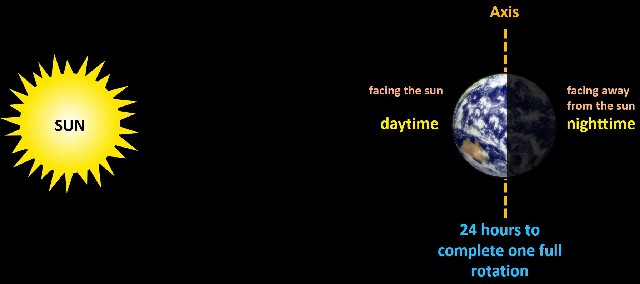 We know that the Earth is spinning in space which is what causes day and night, we know that the Earth is orbiting the sun and that it takes one year to complete one orbit, and we know that the Earth is tilted with respect to what we call the orbital plane and that’s what causes seasons. The orbital plane is the imaginary flat surface on which the Earth orbits.
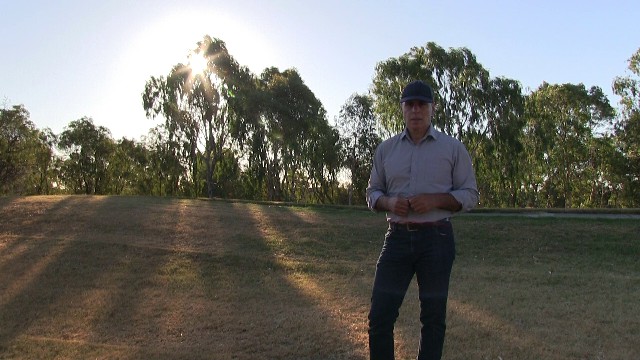
But where is the sun right now? Well, it’s obviously behind me in that direction, but that’s only for me. Can we describe its location with respect to the Earth in a similar kind of way that we use latitude and longitude to express where everything on Earth is? Well, yes we can, with what’s called the subsolar point. The subsolar point is the exact spot on the Earth’s surface where the Sun is directly overhead.
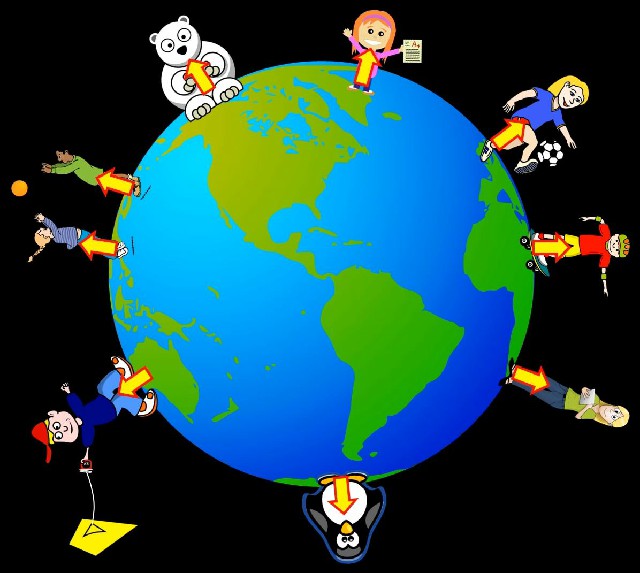
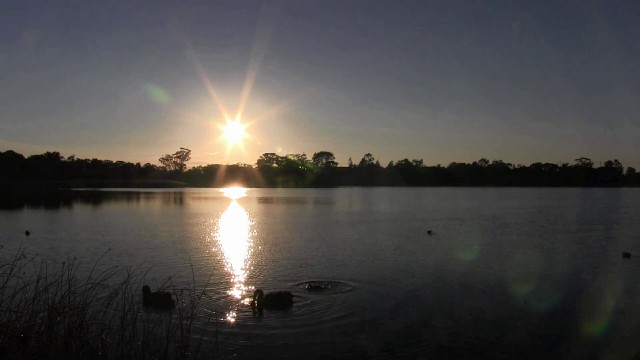 Given that the Earth is a sphere, every point on Earth has its own downwards direction and its own upwards direction and there’s always going to be a point somewhere on Earth where the sun is directly overhead… straight up, 90° above the horizon.
Now even though we now know that the Earth is turning and that’s what gives us day and night, from the Earth’s point of view it looks as if the sun rises every day and then sets every day and it’s often far more convenient to talk about the sun’s position in the sky and its movement across the sky rather than to talk about the Earth’s position in space.
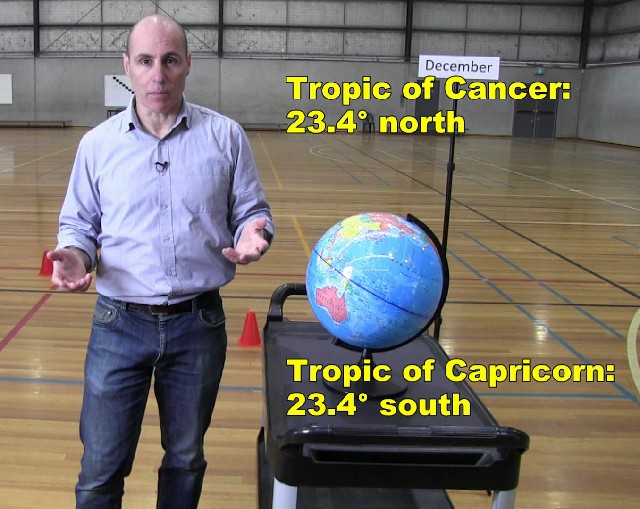 The Tropic of Capricorn, 23.4° south of the equator, and the Tropic of Capricorn, 23.4° north of the equator are two important lines on Earth because the sun can only ever be directly overhead, straight up, if you’re standing between them.
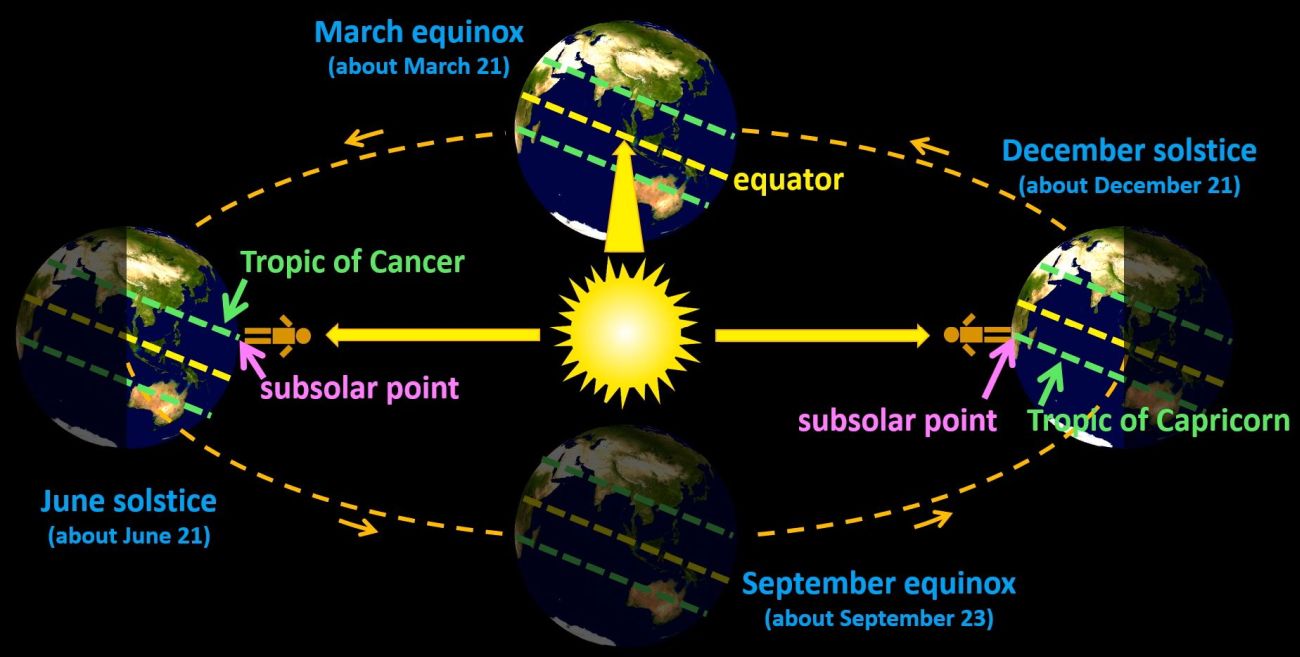
In this animation, we can see that on the December solstice, the sun is directly above the Tropic of Capricorn. The subsolar point is right here. However, six months later, the sun is directly above the Tropic of Cancer, so the subsolar point is here.
Since the Earth is spinning AND orbiting the sun, the subsolar point is constantly moving, but it’s always somewhere between the Tropic of Cancer and the Tropic of Capricorn.
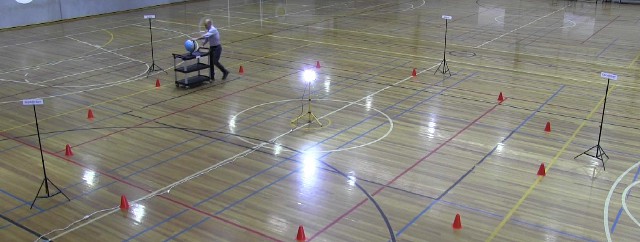 So, let me use a simple model to take a look at how the apparent position of the sun (from the Earth’s point of view) changes throughout the year. The Sun is fixed in the middle and the Earth is on a trolley so that it can orbit the Sun.
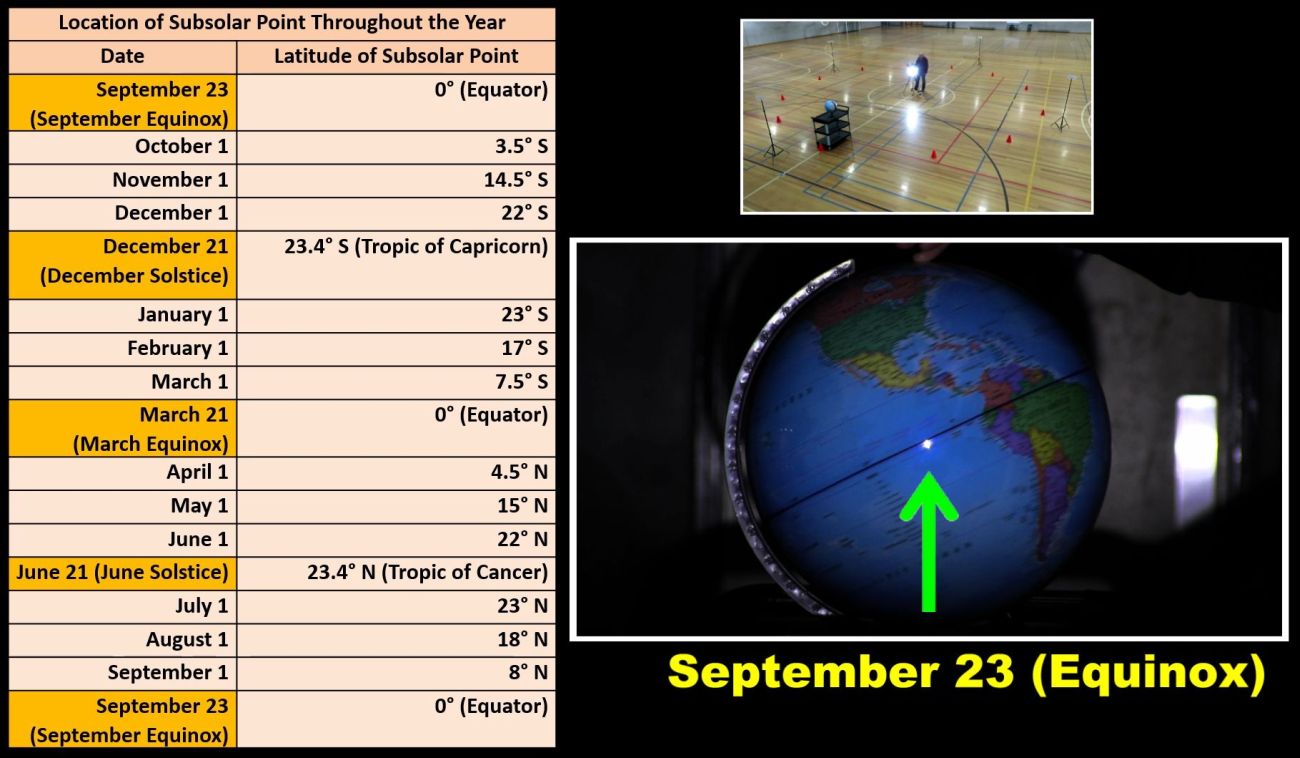
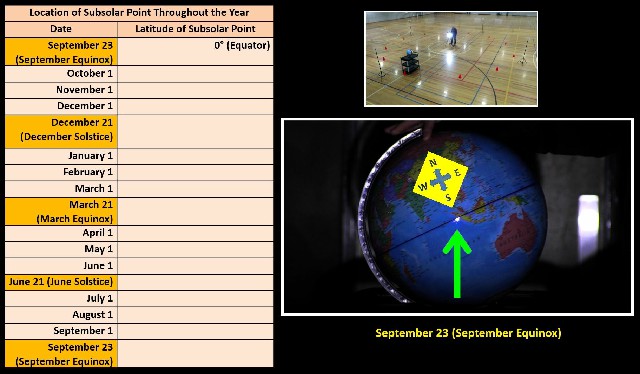 If I set up a camera behind my spotlight (which is our model sun of course), we can see what the earth looks like from the sun’s point of view on September the 23rd, the September equinox, and where the sun is in relation to the Earth. The sun is in fact directly over the equator, so the subsolar point is on the equator. That bright spot there is the actual spotlight reflecting back into the camera.
Since the Earth is spinning from west to east, the subsolar point moves from east to west throughout the day.
We can see it passing over Africa, the Atlantic Ocean, South America and so on.
Let’s see what happens as the Earth moves around the sun and fill in the table as we go.
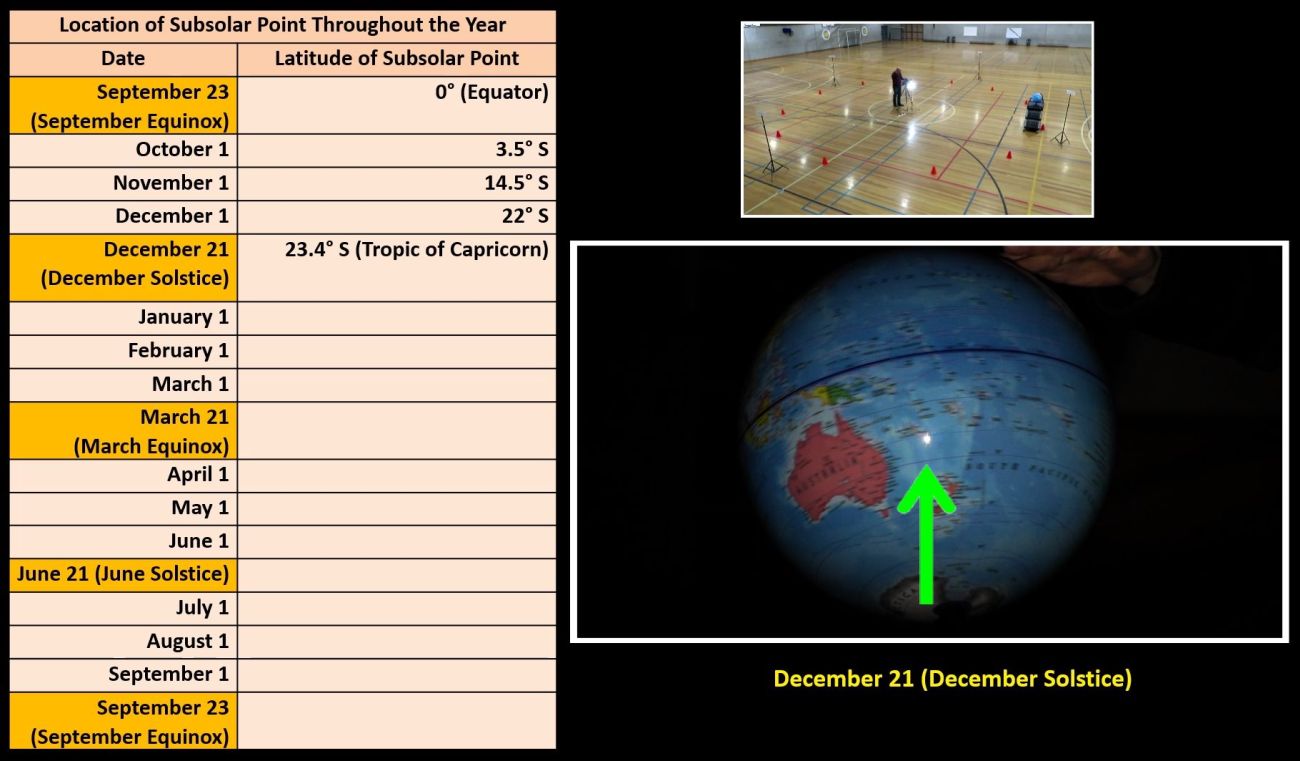
On October the 1st, the sun is no longer over the equator, but about 3.5° south of the equator. In the middle of the day on October the 1st, it will pass directly overhead if you’re standing 3.5° south of the equator.
A month later, on November the 1st, the sun will pass overhead 14.5° south of the equator. On December the 1st the sun is 22° south of the equator and on December the 21st, the December Solstice, it gets to 23.4° south of the equator. This line is called, as I said, the Tropic of Capricorn. As we’ve seen, the Southern Hemisphere gets warmer weather because the sun shines more directly onto it.
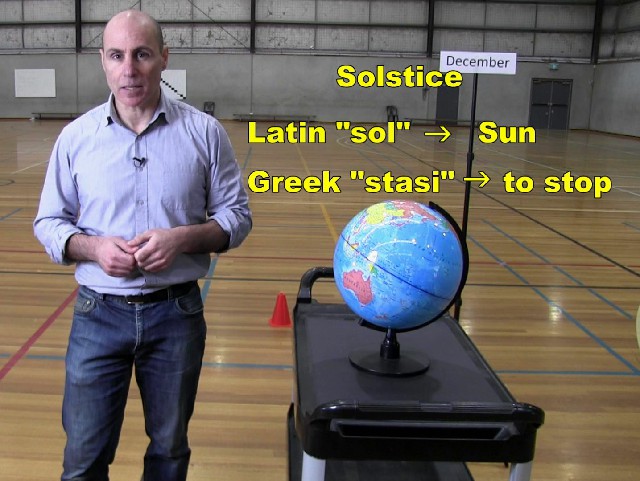 The word solstice comes from the Latin Sol (which means sun) and the Greek stasi (which means to stand still or to stop). The word station as in train station also derives from stasi: the train stops at the train station. On the day of the June Sol-stasi… the solstice as we now say in English, the sun stops moving towards the south (from the Earth’s point of view) and starts moving northwards again.
On January the 1st, the sun has moved back to 23° south of the equator, on February the 1st to 17° south, on March the 1st 7.5° south and then on March 21st, the equinox, the sun is directly over the equator again.
So, if we look at the situation from here, we can see that at the December solstice, the sun is directly over the Tropic of Capricorn which means that the subsolar point is on the Tropic of Capricorn. However, three months later, at the March equinox, the sun is directly over the equator, so the subsolar point is on the equator. Between the December solstice and the March equinox, the subsolar point moves a little northwards every day (while continuing to sweep across the Earth from east to west as the Earth spins).
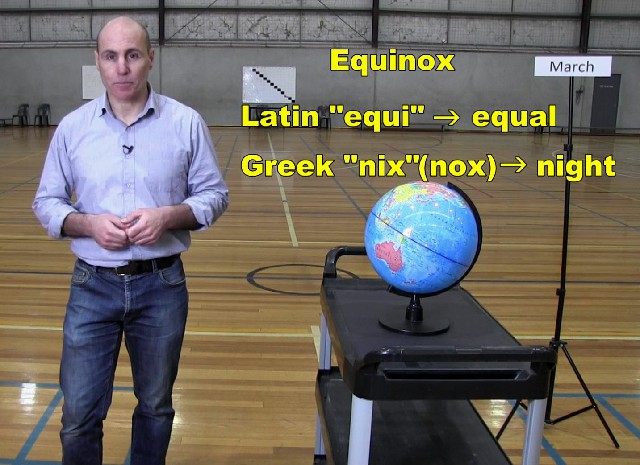 The word equinox comes from the Latin “equi” meaning equal and the Greek “nix”, which was changed in Latin to “nox” meaning night. In modern Greek, night is called nixta. At the equi-nixta, the equinox, the length of daytime and night time are the same: 12 hours each.
By the way, the word nocturnal also derives from nox and nyxta and it describes an animal that is most active at night. Possums are supposed to be nocturnal but I filmed this one during the day while on holidays once. Maybe it had insomnia! Who knows?!
After the March equinox, the sun moves north of the equator (from the Earth’s point of view) and it keeps moving north until about June 21st, the June solstice, when it reaches the Tropic of Cancer (although the plastic arm there is hiding it a little). As I said, the word “solstice” means “sun stop”, so on the day of the June solstice, the sun stops moving north and starts moving southwards again.
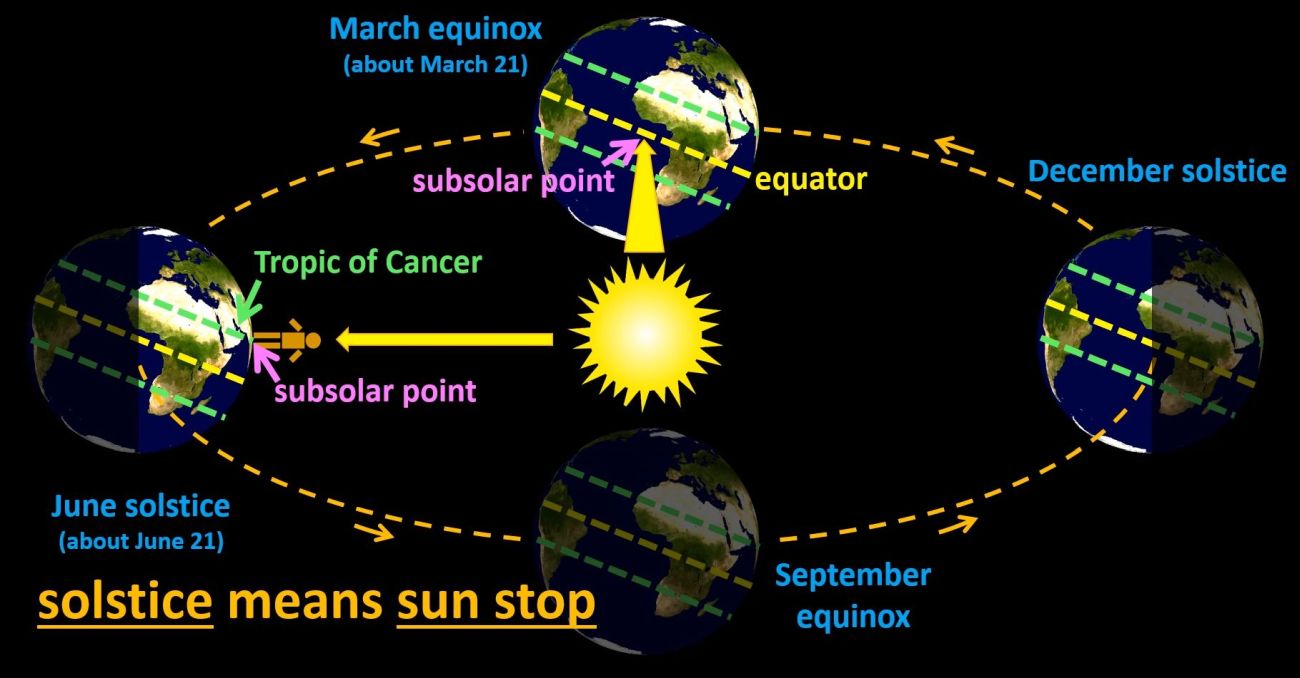
If we look at it from here again, we can see that between the March equinox and the June solstice, the subsolar point moves from the equator to the Tropic of Cancer which means that it continued to move northwards during this period. As I said, at the June solstice, the sun stops moving towards the north (remember, the word solstice means sun stops) and it then starts moving towards the south.
So on July 1st, the subsolar point is about 23° N, and on August 1st, it’s about 18° North. The subsolar point is moving southwards. On September 1st it’s only 8° north of the equator, and on the September equinox (around September the 23rd every year), the subsolar point is back on the equator again.
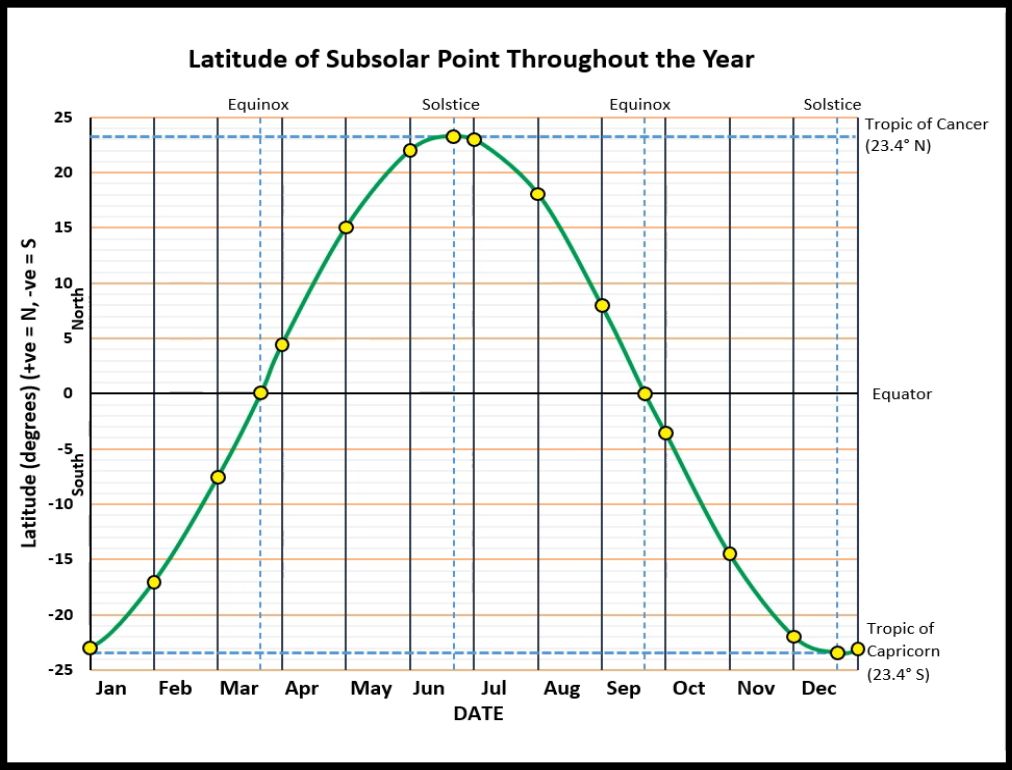
We can generate a graph of the subsolar point’s latitude throughout the year based on the data in the table. We can see that it goes from well south of the equator at the start of the calendar year towards the north, reaching the equator at the March equinox. It then continues to travel northwards before slowing down, stopping its northward movement on the day of the June solstice, and then turning around and heading southwards again.
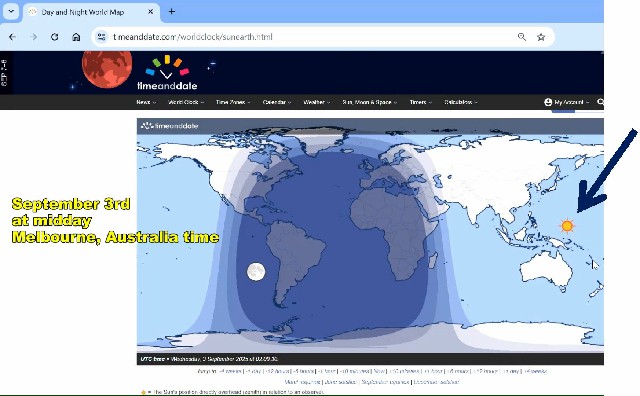 You can actually go to various websites that mark on a map where the subsolar point is at any given time.
For example, if you go to the timeanddate.com website, hover over the Sun, Moon, and Space tab, and then click Day and Night Map, the website will display a map with the sub solar point marked on it. As I produced this screen record on September 3rd at midday Melbourne time (I live in the city of Melbourne, Australia), the sun was over the western Pacific Ocean north of Australia. The map also shows the sublunar point, which is the point on Earth where the moon is directly overhead, but we’re not going to worry about that for now.
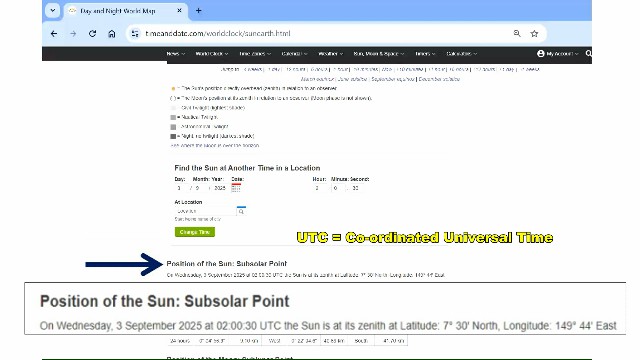 I can scroll down and get more details under the Position of the Sun: Subsolar Point heading. I’ll enlarge the text so that you can see it a little easier. On Wednesday the 3rd of September 2025 at 02 hours, 00 minutes, and 30 seconds, UTC the Sun is at its zenith (which means straight up) at Latitude: 7° 30′ North, Longitude: 149° 44′ East. These are the exact co-ordinates of the subsolar point. UTC stands for Co-ordinated Universal Time, an international time standard that most countries use for international communications and trade.
We can also see that the ground speed of the subsolar point is 460 metres per second or more than 1600 km/hr. The subsolar point moves really fast from east to west as the Earth spins.
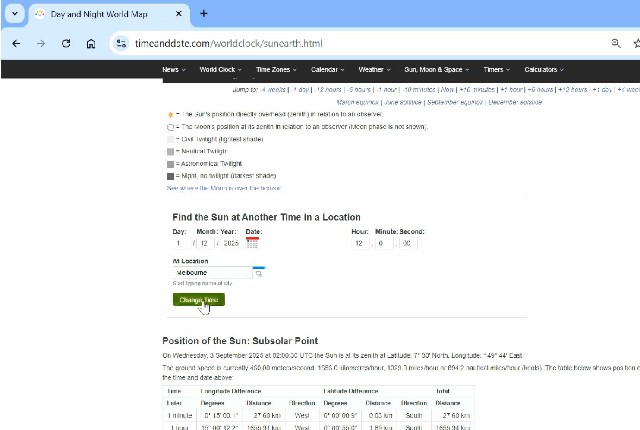
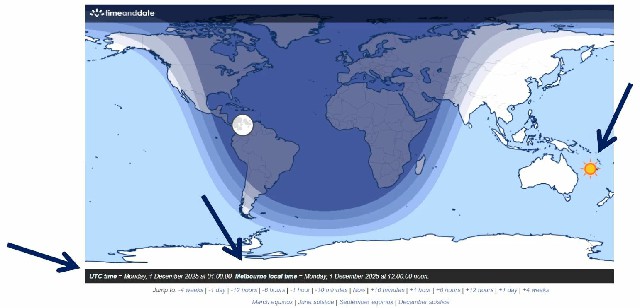
I can also go to “Find the Sun at Another Time in a Location” and set the location as Melbourne, the city I live in, and set whatever date and time I want, say the 1st of December at 12:00 pm. Once I click Change Time, the map shows that the subsolar point at that time will be in the western Pacific Ocean to the east of Australia. It still gives UTC time, but it also displays Melbourne time.
If I scroll down to “Position of the Sun: Subsolar Point” it gives the latitude and longitude co-ordinates of the subsolar point on that date and at that time.
On Monday, 1 September 2025 at 01:00:00 UTC (which is midday Melbourne time on that date) the Sun is at its zenith at Latitude: 21° 49′ South, Longitude: 162° 15′ East.
So the sun is always above a specific point on Earth. Every day, as the Earth spins from west to east, the subsolar point moves from east to west, but over the course of the year it also slowly moves northwards and southwards between the tropics. The subsolar point actually follows a spiral path.
Sometimes we see images of the beautiful universe that we live in and we’re amazed by all the galaxies, the nebulas, the planets, and so on, but to me the yearly rhythmic movement of the sun passing over the earth as if they’re both dancing with each other is just as beautiful.
And so that’s it for our lesson on the subsolar point. Thanks for watching. See you next time.
CREDITS:
Produced by Liacos Educational Media
Some of the content of this video first appeared in Shedding Light on the Sun and Earth Episode 2: Long Hot Summer Days.
Opening and end titles music by Humanoide_Media via Pixabay.
https://pixabay.com/users/12661853/?tab=music&order=latest&pagi=1
https://pixabay.com/music/main-title-star-wars-style-march-165111/
https://pixabay.com/music/main-title-invasion-march-star-wars-style-cinematic-music-219585/
Star-Wars-style opening crawl generated at the STAR WARS Intro Generator website. https://starwarsintrogenerator.com/
Screen recordings were taken from the timeanddate website: https://www.timeanddate.com/